
Pattaya Hotel News: Pattaya’s tourism industry is facing mounting challenges as hotel operators, tourism officials and local businesses warn that the city could be heading toward one of its most difficult high seasons in years. After enduring an unexpectedly weak low season, concerns are now growing that the traditional year-end tourism boom may fall well below expectations, with declining advance bookings, rising cancellations and continuing global uncertainty creating fresh anxiety throughout the hospitality sector. This Pattaya Hotel News report examines the factors behind the slowdown, the growing dependence on the Indian tourism market, and why many industry leaders believe Pattaya must urgently diversify its visitor base if it hopes to restore long-term stability.
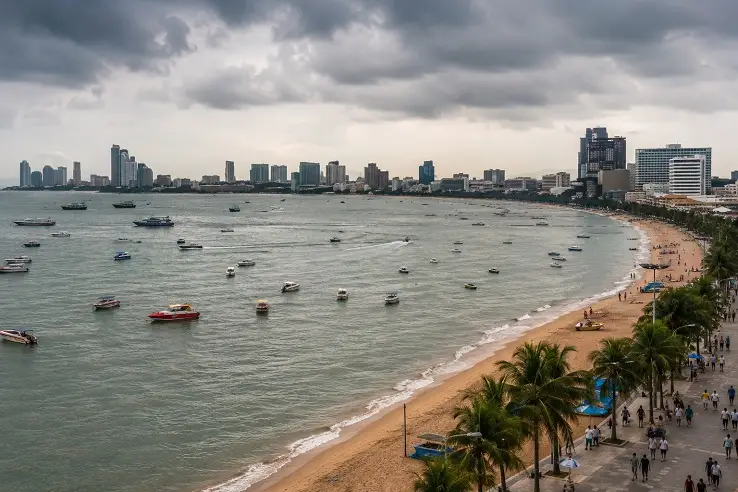
Image Credit: Pattaya Hotel News
The latest figures from the tourism industry paint a worrying picture. Tourist arrivals in Pattaya and the wider Chon Buri province have fallen by an estimated 25 to 40 percent during the low season, while many hotels are operating well below profitable occupancy levels. What is particularly concerning for operators is that the slowdown has been far more severe than normally experienced during the quieter months of the year.
Hotels Struggling to Reach Break-Even Occupancy
According to the Chon Buri Tourism Federation and the Thai Hotels Association Eastern Chapter, many hotels are currently recording occupancy rates of only 15 to 20 percent. Industry experts estimate that most hotels require occupancy of at least 40 to 50 percent simply to cover operating costs, leaving many businesses under significant financial pressure.

Unlike previous years, when family travelers continued supporting Pattaya’s tourism market after the April and May holiday period, visitor numbers have declined sharply. Tourism officials say this year’s contraction has been considerably more pronounced than expected, with little evidence of the gradual recovery usually seen during the early stages of the low season.
Many hotel operators have responded by introducing aggressive room discounts, reducing staffing levels and delaying non-essential maintenance in an effort to reduce operating expenses while waiting for stronger demand.
Meetings and Conferences No Longer Filling Hotels
One of the biggest contributors to the downturn has been the sharp decline in meetings, seminars and government-related travel.
Tourism officials say the government’s work-from-home policy has resulted in some agencies interpreting current budget guidelines as discouraging off-site meetings and conferences. For years, these events provided hotels with valuable business during quieter tourism periods, helping maintain occupancy when international leisure travel slowed.
This year, however, that important market has contracted substantially, removing a reliable source of revenue that many hotels traditionally depended upon during the low season.
Airline Reductions Add More Pressure
The tourism slowdown has also been aggravated by reduced air services.
Several low-cost and commercial airlines have either reduced frequencies or suspended certain routes due to weaker passenger demand and rising fuel costs. Fewer available flights naturally mean fewer visitors arriving in Pattaya, placing additional strain on hotels, restaurants and tourism-related businesses throughout the city.
Industry representatives believe restoring airline capacity will be essential if Pattaya hopes to experience a meaningful recovery during the coming high season.
Indian Market Provides Stability but Recovery Remains Uneven
Despite the overall slowdown, the Indian market continues to play an increasingly important role in supporting Pattaya’s tourism industry.
As China’s international travel recovery remains inconsistent, Indian visitors have become one of the city’s fastest-growing international markets. Larger hotels, particularly those accommodating organized tour groups, business travelers and increasingly popular Indian wedding celebrations, have benefited from this growing demand.
These visitors help maintain occupancy levels and generate valuable revenue for many medium and large hotel properties.
However, many smaller businesses say they are not experiencing the same level of recovery.
Restaurant owners, street vendors, retail shops and independent tourism operators report that although there are often large numbers of visitors walking through Pattaya, daily sales remain significantly lower than in previous years.
One local vendor explained that businesses which once generated several thousand baht per day are now sometimes struggling to earn even a fraction of those amounts despite busy streets.
Package Tours Limit Local Spending
Industry analysts suggest the issue is not simply the number of tourists arriving but how and where tourism spending is distributed.
Many Indian visitors travel on organized package holidays where accommodation, transportation, meals and sightseeing activities are arranged before arrival. As a result, much of their spending remains within selected hotels, restaurants, transport providers and tour operators rather than flowing throughout the wider local economy. Most of these businesses that the Indians patronize are owned either by Thai Punjabis or in some cases by Indians from India using illegal nominee setups.
Economic experts stress that this should not be viewed as a criticism of any particular nationality, but rather as a structural characteristic of packaged tourism that can limit economic benefits for independent businesses.
Hotel operators acknowledge that the Indian market has become an essential pillar of Pattaya’s recovery but also emphasize that relying too heavily on one source market creates long-term risks.
Europeans, Chinese and Japanese Staying Away Due to Strong Indian Presence in Pattaya
Many Europeans, Chinese and Japanese tourists are giving Pattaya the miss after reports emerged that the city is full if Indians these days coupled with the fact that some parts of Pattaya is beginning to resemble Indian slum cities with Indian Restaurants, India Hotels, Indian Nightclubs and Indian businesses and Indians everywhere.
There are speculations that there are now even Indian prostitutes operating in Pattaya coupled with rumors that various Indian mafias groups are also operating there. Some high-profile cases of extortion by Indian groups and Indian call center scammers in the city in the media have also added credibility to the claims of Pattaya being overtaken by Indian mafia.
Industry Calls for Greater Market Diversity
Tourism leaders continue encouraging authorities to strengthen marketing efforts aimed at attracting visitors from Europe, China, South Korea, the Middle East and other international markets.
Some business owners have expressed concerns that changing visitor demographics may influence the travel choices of certain traditional markets. However, industry experts caution that there is no definitive evidence that European or Chinese visitors are avoiding Pattaya solely because of the growth in Indian tourism. They note that international travel decisions are influenced by numerous factors, including exchange rates, airline capacity, global economic conditions, geopolitical tensions and changing consumer preferences.
The broader consensus within the industry is that Pattaya’s long-term success depends upon maintaining a healthy balance of visitors from multiple countries rather than relying heavily on any single market.
The Tourism Authority of Thailand continues identifying India as one of Thailand’s highest-potential tourism markets while simultaneously working to attract visitors from many other regions through international promotions and major events.
Thailand welcomed approximately 32.97 million international visitors during 2025. Malaysia accounted for around 4.52 million arrivals, followed by China with approximately 4.47 million visitors, India with about 2.49 million arrivals and Russia with roughly 1.90 million tourists.
These figures demonstrate the importance of maintaining a diversified tourism strategy that supports sustainable growth across all sectors of the industry.
High Season Outlook Raises Fresh Concerns
While businesses traditionally rely on the final quarter of the year to offset weaker low-season trading, many operators now fear that 2026 could deliver one of Pattaya’s poorest high seasons in recent memory.
Hotel executives report that advance bookings for the year-end holiday period remain significantly below expectations, while cancellations have become increasingly common.
The continuing conflicts in the Middle East, higher fuel prices, elevated travel costs and ongoing economic uncertainty across many countries are making consumers more cautious about international travel.
If these trends continue, Pattaya’s hotels could face a difficult festive season despite normally being one of the city’s busiest periods.
Tomorrowland Offers Hope but Expectations Remain Measured
There is, however, one major event likely to generate additional visitor interest.
Tomorrowland Thailand is scheduled to hold its first-ever full-scale Asian edition in Pattaya from December 11 to 13, 2026. The internationally renowned electronic music festival is expected to attract thousands of domestic and international visitors while generating worldwide media attention.
Even so, many tourism professionals believe expectations surrounding the event should remain realistic.
Although Tomorrowland will undoubtedly provide a welcome boost for hotels and businesses directly associated with the festival, many industry observers believe it is unlikely to reverse the broader challenges facing Pattaya’s tourism sector or single-handedly rescue what is shaping up to be a difficult high season.
Pattaya’s tourism industry now finds itself at an important crossroads. While operators remain hopeful that bookings will strengthen during the months ahead, many acknowledge that the city faces a combination of challenges unlike any experienced in recent years. Restoring airline capacity, rebuilding confidence among traditional long-haul markets, broadening the mix of international visitors and ensuring tourism spending reaches businesses of every size will be critical if Pattaya is to achieve a more balanced and sustainable recovery. The months ahead will therefore be decisive not only for hotels but for the entire local economy that depends so heavily on tourism.
For the latest on the state of the hospitality industry in Pattaya, keep on logging to Pattaya Hotel News.